
IPA has become the 2017 equivalent of the East Coast vs. West Coast rap wars, minus the gunplay and MTV coverage. The West Coast IPA fans stick to their theory that you can have a clear IPA that exhibits good aroma, flavor, and bitterness, all while being able to read Facebook on your phone through your glass. The New England IPA fans stick to their “juicy” love affair with beers that look more like orange juice than beer. I find myself to be more Oklahoma than either coast in this ongoing debate.
Why are these New England IPAs so damned cloudy? Multiple opinions exist on what contributes to the haze, but everyone agrees that yeast plays a major part. The choice of most brewers producing this new style tends to be the Vermont Ale, Vermont IPA, Northeast Ale, or Konan yeast (the same strain under different marketing) which stays in solution rather than flocculate to the bottom. The yeast, while in suspension, adds mouth feel and “body” to a beer much in the same way corn starch tends to thicken soups or sauces. The yeast doesn’t necessarily make the beer thicker, but it adds to the appearance of viscosity. Other theories on the haze involve the use of higher starch grains like oats, spelt, wheat, flour, etc., and “hop haze,” which is created by heavily dry-hopping a beer.
Last year I made a DIPA called Lyle Crocodile in honor of a friend. The beer relied heavily on toasted oats, toasted rice and more hops than I had ever used previously. As you can see from the picture, it came out opaque. I used White Labs’ WLP001 California Ale yeast, which flocs out easily, so the yeast didn’t make it to the secondary fermentation carboy, or the keg, but the haze is still there. I also used White Labs’ Clarity Ferm product, which eliminates the proteins that form the dreaded “chill haze.” Lyle Crocodile’s haziness simply came from the high percentage of oats and the near-pound of hops in the five-gallon batch, the majority of hops were in the dry-hopping, which adds phenols, which are hazy. The beer tasted super-clean, had none of the New England IPA’s characteristic “juicy” mouthfeel, and although hazy, was clearer than just about every New England IPA I have tried. Lyle Crocodile was so well received at a party I threw, that it was the first keg to kick. Everyone raved about it, which probably had something to do with the 8.5% ABV a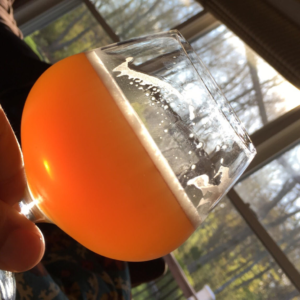 nd everyone being completely smashed.
But for commercial brewers I have a theory that time and money are the key elements in the rise of New England IPA popularity. If you don’t have to filter, or add finings to help clear up the beer, you save money. If you don’t have to wait for the yeast to “floc out” to the bottom of the fermenter, you save time, which means you can turn beers around quicker. If time = money, and you can both get your beers to market faster and produce more beer, you net a much larger profit margin.
I think it’s possible to brew an amazing Double IPA (DIPA) that doesn’t look like you dumped a bag of flour in it. Take Russian River Brewing’s Pliny the Elder (the first DIPA), for example. You can read this post through it. I guess super cloudy IPAs and DIPAs could just be a trend, one that I have obviously taken part in. But will it last? Will the Brewers Association add New England IPA as an official style?
Ultimately this is a consumer choice. It is possible to brew a clearer IPA/DIPA, but does it matter? If you have created a huge buzz about your beer and people are standing in line in the rain for two hours to buy it, you are too busy counting your money to discuss the haziness in your product. The market is obviously being driven by sales, as there are some very good brewers on the west coast that are now producing their own versions. It looks like this new trend is going to be around for a while, but I remember when the market was being overrun with “Cascadian Dark Ales,” as well as white and Belgian IPAs. Now you have to actively search for one of those styles and this new “hop soup” style has seemed to take their place.
So where do you fall in the IPA rap wars? Fans of both? Fans of neither? Or just fans of beer exploration?
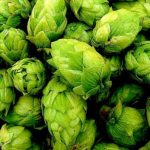 Everyone knows a fresh-picked tomato in late July/August makes the best BLT in the world. An apple pulled off the tree in September/October tastes like nothing else. So why don’t we seek beers like that? We do. The beer world loses its collective mind over some seasonal releases. Take Dogfish Head’s pumpkin beer. Dogfish Head will not brew it without freshly processed pumpkins. Then look at all the “wet hop” or “fresh hop” beers. Brewers have a limited window to get these hops and only hours to brew with them. That’s what makes these beers great.
 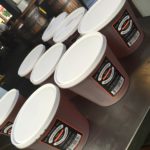 eer using Gargoyle and Cascade hops. In a 7,000-mile round trip, the Brew Master flew to California, procured the hops, and flew back the same day. Straight from the airport and into the brew kettle. You cannot fake it; you cannot freeze the hops and call it “fresh hopped” beer. You cannot move the date forward for fiscal expediency. You just can’t.
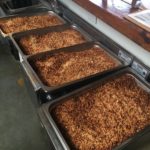 aroma. It smelled like heaven for almost an hour. Then, raw, unfiltered honey was added for body and to dry out the beer little. Truly, the brewing of this genuinely seasonal beer was amazing, and it will be the first real “honey nut brown” I have had in quite a while. A higher mash temp, a great malt bill and some care will create a truly original, and more importantly, truly SEASONAL beer.
 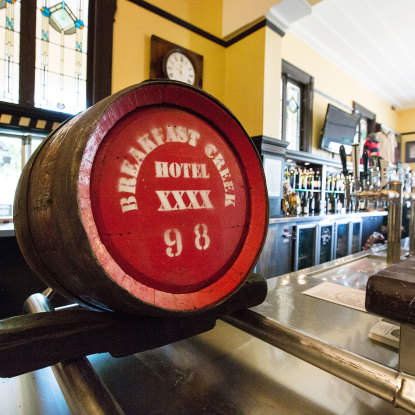 I had another interesting experience with cask conditioned beer on my second trip to Brisbane, Australia. A friend of mine had been there many times, and knew of a place called The Breakfast Creek Hotel (the locals call it the “Brekky Creek”). This place had the best steak house going (the kind where you choose your steak in the case) and the Paddy Fitzgerald Bar, a really cool bar that still serves cask ale. The beer was XXXX Bitter (spoken “four-ex”),made by Castlemain Perkins in Brisbane, Australia. On its own merit, XXXX Bitter is a good beer, a kind of English bitter hybridized with a Czechoslovakian lager yeast. It is great, 4.6% ABV, and crushable. The XXXX Bitter on cask at the Brekky Creek is from another world. There is something amazing that happens in the cask. I don’t know if it is the brewers pitch, the wood, the tradition, or the specter of seeing it tapped with a hammer…but it is amazingly different. I have consumed many, many pints of XXXX Bitter, “off the wood” as the barman says, while at the Brekky Creek and they were all amazing. The cask mellows all the flavors a bit. The bittering from the hops is toned down, and the wood adds a different mouthfeel than you would get from a bottle of standard CO2 draught. The differences to most people would be significant enough to suggest the cask and non-cask versions of the same beer were actually two different beers. As a really cool side note to the Paddy Fitzgerald Bar fame, I would add that they have a very interesting tradition regarding a tapped cask. They finish it that day. Don’t get me wrong, they are small casks (10 gallons/38 liters I believe), but those of you sitting in the bar within an hour of closing could get a special treat. The last time I was there, in 2006, I happened to be there with only four other patrons – two locals and three of us Sailors. The locals kindly accepted the free pitcher that the barman poured for them and took a while to consume it. My friends and I went through pitcher after pitcher of wonderful beer while discussing such lofty topics as US football vs. Rugby, Rugby Union, and Australian Rules. We also debated who had consumed more, and which of us had the largest bladder (Big Head Todd drank way more, and I had the largest bladder).